Key takeaways
- A healthy pipe looks smooth with tight joints
- Roots, offsets and cracks are visible at joints
- Standing water marks low spots
- Distance and notes make the footage usable
What healthy pipe looks like
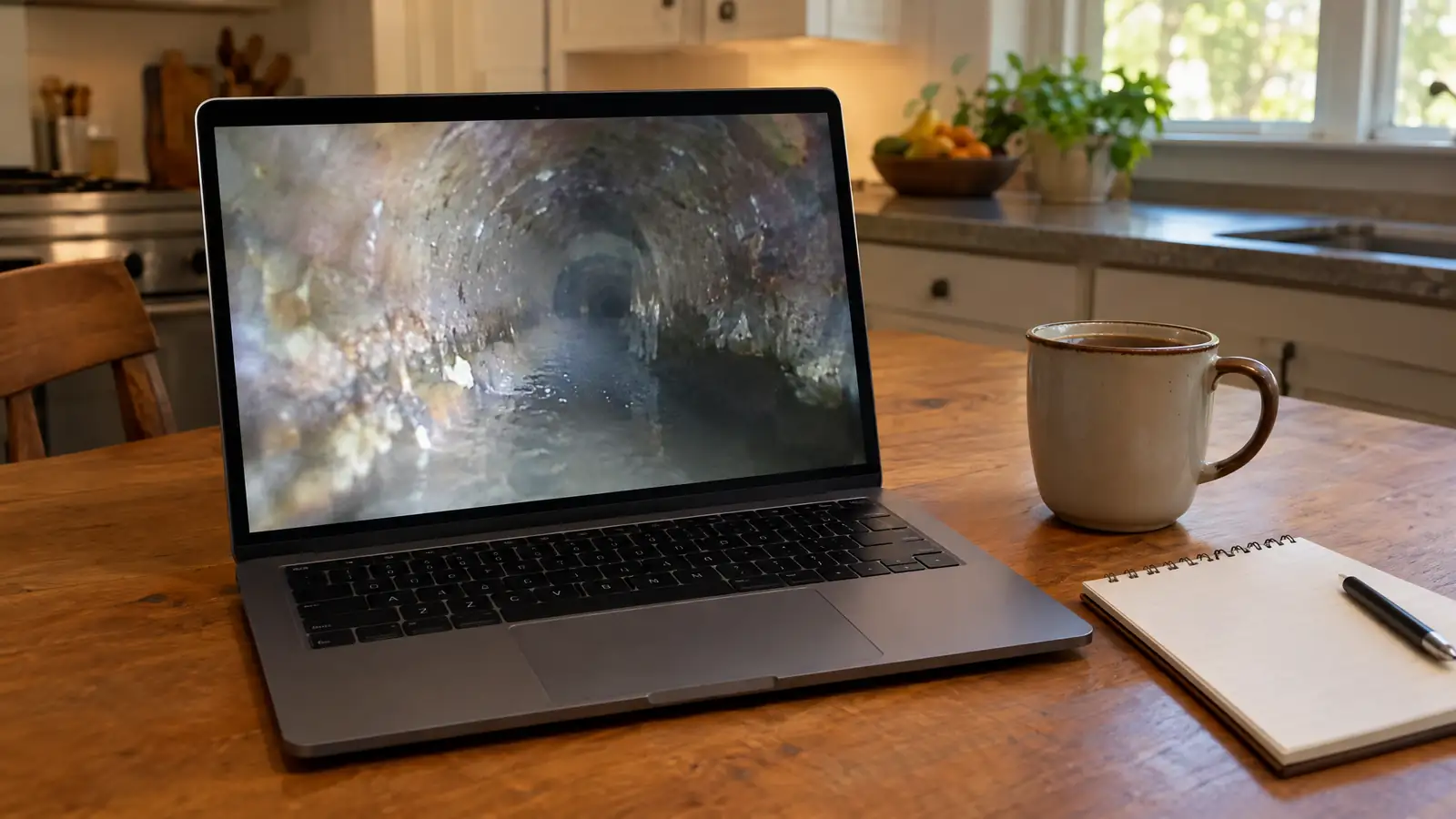
A sound line looks like a clean, round tunnel. The walls are smooth, the joints are tight and aligned, and any water is a thin film on the bottom, not a pool.
Plastic pipe is smooth and light. Clay is rougher, with a joint every few feet. Cast iron is dark, with some rough texture even when fine.
Common warning signs
Fine white hairs or a thick brown mass at a joint are roots. A stepped edge where two sections meet is an offset joint. A dark line along the pipe is a crack. A pool of water that does not drain is a belly.
Heavy rust scale, flaking, or a pipe that looks oval rather than round are signs of an aging line.
What is urgent
A collapsed pipe, a break with soil entering, a line blocked solid with sewage backing up, or a utility line crossing through the pipe are urgent. These affect health, safety or the property.
Most other findings are monitor-or-plan items. The report should say which is which.
Why the numbers matter
Footage without distance is hard to act on. A crack at 38 feet tells a repair crew where to dig. Depth and surface marking add to that. Always ask that findings include a distance.
Keep the video. It is a baseline you can compare to a later inspection.
Quick answers
Can I understand the footage myself?
With a little help, yes. The Defect Decoder on this site shows what common problems look like.
What if I disagree with a contractor’s reading of it?
Share the video with a second professional. Good footage can be reviewed by anyone.
Want a professional look at your own pipe?
Schedule a camera inspection with the form below, or call (615) 952-0844.